LANGUAGECERT Academic CEFR Levels: A1 to C2 Explained


 14 Jul 2026
 9 min read
 282 views
Summarise blog with AI





Your CEFR level does not measure your intelligence or education. It simply shows how well you can use English in real-life situations.
Before you book your LANGUAGECERT Academic exam, make sure you know:
The CEFR level you need
Whether your university or organization accepts LANGUAGECERT Academic
The score requirements for your application
What Is the CEFR?
The Common European Framework of Reference for Languages (CEFR) is an international system used to measure English ability.
There are six levels:
| CEFR Level | Ability |
|---|---|
| A1 | Beginner |
| A2 | Elementary |
| B1 | Intermediate |
| B2 | Upper-Intermediate |
| C1 | Advanced |
| C2 | Proficient |
| Level | What You Can Usually Do |
|---|---|
| A1 | Understand simple words and introduce yourself. |
| A2 | Handle everyday conversations and write short messages. |
| B1 | Communicate independently on familiar topics. |
| B2 | Understand more complex English and explain your ideas clearly. |
| C1 | Use English confidently for university and professional situations. |
| C2 | Understand almost everything and communicate with great accuracy. |
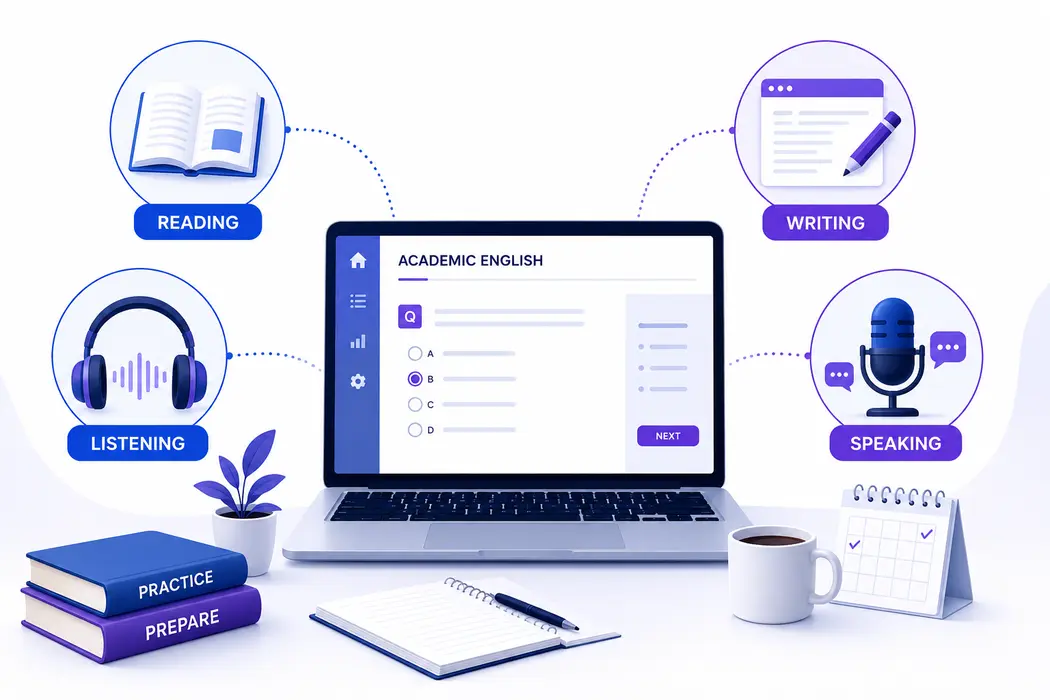
LANGUAGECERT Academic measures your English through Reading, Listening, Writing, and Speaking, and your result is linked to one of these CEFR levels.
CEFR Levels at a Glance
The levels build over time, although listening, writing, and speaking do not always improve at the same pace.
| CEFR level | General stage | What you can usually do |
|---|---|---|
| A1 | Beginner | Use familiar words, give basic personal details, and understand slow, clear speech. |
| A2 | Elementary | Handle routine exchanges and understand short, simple messages. |
| B1 | Intermediate | Manage common situations independently and discuss familiar topics. |
| B2 | Upper-intermediate | Follow more complex material and explain opinions with reasonable fluency. |
| C1 | Advanced | Use English flexibly for demanding academic and professional tasks. |
| C2 | Proficient | Understand almost everything and express precise meaning with high control. |
A higher CEFR band does not mean every sentence will be perfect. It means you can communicate effectively across a wider range of situations.
Why Your Target Level Matters
Different organizations ask for different CEFR levels.
For example:
- Many universities ask for B2 or C1.
- Some employers focus on speaking and writing.
- Visa or immigration authorities may require a specific LANGUAGECERT exam and minimum scores in each skill.
Before registering, check:
- Whether they accept LANGUAGECERT Academic
- The required CEFR level or score
- Minimum scores for Reading, Listening, Writing, and Speaking
- Application deadlines
Have Questions About Your LANGUAGECERT Test?
Contact UsWhat You Can Do at Each CEFR Level
A1 and A2: Basic English
A1
At A1, you can:
- Introduce yourself
- Ask simple questions
- Give basic personal information
- Understand slow, clear English
For example,"My name is Ana. I live in Chicago. I study English three times a week."
A2
At A2, you can:
- Talk about work, family, shopping, and travel
- Read short notices
- Write simple emails and messages
For example, you could write a short email explaining why you missed class.
These levels build a good foundation, but they are usually not enough for university study.
B1 and B2: Independent Communication
B1
At B1, you can:
- Understand the main ideas in conversations and texts
- Describe experiences and future plans
- Write connected paragraphs
- Join everyday conversations
For example, you can read a work email and reply with a clear answer.
B2
At B2, you can:
- Understand longer discussions
- Read more difficult texts
- Explain your opinions with reasons
- Write organized essays and reports
For example, you can discuss a topic in class and respond to other people's ideas.
Many universities accept B2, but every institution has its own requirements.
B2 shows strong independent English skills, but it does not automatically meet every university or professional requirement.
C1 and C2: Advanced English
C1
At C1, you can:
- Understand difficult texts
- Express complex ideas clearly
- Write well-structured arguments
- Speak confidently in academic or professional settings
For example, you can compare two articles and explain which one is more convincing.
C2
At C2, you can:
- Understand almost everything you hear or read
- Use English naturally and accurately
- Express very detailed ideas
- Combine information from different sources
C2 represents a very high level of English, but it does not mean you know every English word or accent.
How LANGUAGECERT Academic Tests Your English
Academic English asks you to do more than hold a casual conversation. You may need to understand an argument, identify evidence, explain a position, or produce a focused written response.
The exam measures all four language skills.
Reading and Listening
These sections test whether you can:
- Understand the main ideas
- Find important details
- Recognize the writer's or speaker's purpose
- Follow arguments
At higher CEFR levels, vocabulary recognition is only part of the task. You also need supporting details, tone, purpose, and links between points. Reading academic articles and listening to lectures are excellent ways to improve these skills.
Speaking and Writing
The Speaking test looks at:
- Fluency
- Pronunciation
- Grammar
- Vocabulary
- Communication skills
How well you support an opinion is also checked. Giving longer, well-supported answers usually shows your English ability better than very short responses.
The Writing test checks:
- Task completion
- Organization
- Grammar
- Vocabulary
- Appropriate tone
Memorized answers usually do not score well because they often do not answer the actual question.
How to Choose Your Target CEFR Level
First, find out what your university, employer, or organization requires. Then compare that with your current English level.
A placement test and official practice tests can help you identify your strengths and weaknesses in all four skills. Strong reading skills cannot always make up for weaker speaking or writing skills.
Understanding Your LANGUAGECERT Result
Your LANGUAGECERT result includes a score and a certificate.
The LANGUAGECERT CEFR level helps explain what your score means.
Which CEFR Level Should You Aim For?
B1
Suitable if you need basic independent communication in everyday situations.
B2
A common requirement for university study and many workplaces.
C1
Often required for demanding university programs or professional careers that involve advanced reading, writing, and discussion.
C2
Best for learners who need near-native English ability.
Understand the LANGUAGECERT Exam Format
Explore Exam FormatHow to Prepare for Your Target Level
Common Mistakes Candidates Make
Many candidates:
Regular LANGUAGECERT practice and feedback can help you avoid these mistakes. ALFA LANGUAGECERT provides real-time feedback and abundant practice material.
Checklist Before Booking Your Exam
Before you register, make sure you know:
- The correct LANGUAGECERT Academic exam
- The required CEFR level
- Overall score requirements
- Minimum scores for each skill
- Test center or online requirements
- Registration deadlines
- Identification requirements
- Result release time
- Retake policy
How Can ALFA LANGUAGECERT Academic Help?
ALFA LANGUAGECERT Academic helps you identify your current English level and prepare for the score you need.
The platform offers:
Whether you're aiming for B1, B2, C1, or C2, ALFA helps you prepare with confidence.
FAQs
1. What is the CEFR in LANGUAGECERT Academic?
2. Which CEFR level do I need for university admission?
3. How can I find my current CEFR level?
4. Can I have different CEFR levels for different skills?
5. How can ALFA LANGUAGECERT Academic help me reach my target CEFR level?
6. Is a CEFR level the same as a school grade?
7. Does B2 guarantee university admission?
8. Can I retake LANGUAGECERT Academic?
Final Thoughts
The CEFR levels, from A1 to C2, show your progress in English as your skills improve.
Before taking the LANGUAGECERT Academic exam, always confirm the exact requirements of the university, employer, or organization you're applying to.
Know your target level, practice all four skills regularly, and use ALFA's preparation materials to give yourself the best chance of success.
Start Your LANGUAGECERT Practice Now
Sign In